
Statistical Sampling (Part 3) – My famous sample size spreadsheet

In DoD, the parameters for a statistical sampling inventory are usually dictated. For example, DLM 4000.25-2 lists the confidence level at 95% with a margin of error of +/- 2.5% for most inventories. That should be enough information to proceed with sampling.

However, I often get asked questions about statistical sampling as it relates to inventory. By far, the most common question that I get asked is how to determine the sample size.  There is no shortage of sources, including those in my previous article, that cover this subject and even provide reference tables.

Unfortunately, there is also no shortage of businesses and organizations that take advantage of the situation to try to make money.  If you are someone concerned with DoD Financial Improvement Audit Readiness (FIAR), and follow the trail from OMB Circular A-123 to Audit Unit (AU) Section 350, and search for guidance on statistical sampling, you will likely arrive at many for-sale products. The American Institute of Certified Public Accountants publication on audit sampling is one of many examples; at $99 a copy, I cannot recommend it, so please do not waste your money.

Some time ago, after helping someone with a question about sample size, the person asked me how I knew this and whether it was ok for the government to use “my” method. I proceeded to inform that person that statistics is mathematics and, despite what the AICPA wants to sell on their web site, it is not a proprietary method. Therefore, any statistics textbook is a perfectly good reference to validate any statistical method.

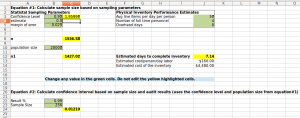
So I decided many years ago to develop a spreadsheet meant to illustrate and teach how sample size is calculated. Over the years, I have shared it and people keep asking me for it to this day.  If you would like to use it, here is the link: https://www.ncg-consulting.com/files/StatisticalSamplingInventory_v2.xlsx
 

Statistical Sampling (Part 2) and Book Recommendation of the Month

As I discussed a while back, statistical sampling is one of the best methods to establish the validity of inventory without having to embark on lengthy and expensive wall-to-wall inventories.

However, there can be a lot of confusion as to how to actually perform statistical sampling inventories and what it all means.  So let me begin by recommending two publications that I believe offer excellent background.

The first one is Sampling Techniques (3rd ed.) by William G Cochran.  This is a textbook (meaning that it is expensive), but one can find used copies online for under $15. It is extremely comprehensive and perhaps too advanced for our needs. However, it is the best textbook on the subject available for the money, in my opinion.

The next book I will recommend is actually free. The best all around publication, in my opinion, on concepts and techniques for conducting statistical tests is GAO’s Using Statistical Sampling, publication PEMD-10.1.6, freely available online for download. Click on the image above to go to the site.

Now, after sending you reading, I should say that, in order to conduct a statistical sampling inventory we need to know very little statistics.  A lot of the confusion is driven by the terminology and interpretation, which is why it helps to understand the background.


Engineering and Logistics

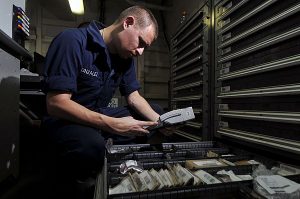
(U.S. Navy photo by Mass Communication Specialist Apprentice Andrew K. Haller/Released)

To those unfamiliar with the field of military logistics, it might come as a surprise that the discipline they understand simply as “logistics”, in its full breadth and scope, is actually Logistics Engineering science.  Although my job has me spending a lot of time on the field in warehouses and labs, even members of my own family express surprise when they learn that my academic background is in computer science and mathematics. People who are familiar with concepts such as reliability engineering, forecasting, and data analytics, immediately understand the relationship between logistics and engineering.

After I retired from the Navy, I was fortunate to join the American Society of Naval Engineers (ASNE) and felt right at home. Even more so, after I read their code of ethics and recognized it as many of my own personal principles that I had been following throughout my career. Therefore, I would like to share those principles with the readers and hopefully they will be of use:

American Society of Naval Engineers (ASNE) Code of Ethics

1. We will only accept assignments we are qualified to perform, and we will perform at a high level of professional competence.

2. We will conduct ourselves in accordance with both the letter and the spirit of the applicable laws and regulations of jurisdictions where we perform engineering within our discipline.

3. We will be alert to the totality of our conduct so that a series of actions, each falling within the technical parameters of the law, when viewed together will not give the appearance of improper or unethical behavior.

4. We will not accept assignments that place us in conflicting roles that may bias our objectivity or judgment. Compensation will not be accepted from more than one party, even if permitted by law, without the full knowledge of all parties involved. Real or apparent conflicts of interest will be fully disclosed to the affected clients at the earliest opportunity.

5. We will not disclose sensitive information to third parties without specific authorization. Sensitive information obtained will be safeguarded from disclosure.

6. We shall neither discriminate against nor deny equal professional service to any person for reasons of age, race, creed, sex, or country of national origin.

7. We shall neither seek unfair advantage over other naval engineers nor publicly disparage the professional performance of another engineer and shall perform engineering within our discipline so as to avoid unnecessary controversy.

8. We shall conduct business and advertise in a restrained and highly professional manner avoiding exaggeration and misrepresentation.

9. We will work to the mutual benefit of the Society and the Naval Engineering profession by sharing the lessons of experience and professional study with fellow naval engineers.