
Statistical Sampling (Part 3) – My famous sample size spreadsheet

In DoD, the parameters for a statistical sampling inventory are usually dictated. For example, DLM 4000.25-2 lists the confidence level at 95% with a margin of error of +/- 2.5% for most inventories. That should be enough information to proceed with sampling.

However, I often get asked questions about statistical sampling as it relates to inventory. By far, the most common question that I get asked is how to determine the sample size.  There is no shortage of sources, including those in my previous article, that cover this subject and even provide reference tables.

Unfortunately, there is also no shortage of businesses and organizations that take advantage of the situation to try to make money.  If you are someone concerned with DoD Financial Improvement Audit Readiness (FIAR), and follow the trail from OMB Circular A-123 to Audit Unit (AU) Section 350, and search for guidance on statistical sampling, you will likely arrive at many for-sale products. The American Institute of Certified Public Accountants publication on audit sampling is one of many examples; at $99 a copy, I cannot recommend it, so please do not waste your money.

Some time ago, after helping someone with a question about sample size, the person asked me how I knew this and whether it was ok for the government to use “my” method. I proceeded to inform that person that statistics is mathematics and, despite what the AICPA wants to sell on their web site, it is not a proprietary method. Therefore, any statistics textbook is a perfectly good reference to validate any statistical method.

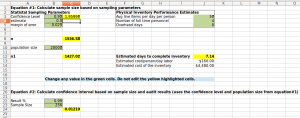
So I decided many years ago to develop a spreadsheet meant to illustrate and teach how sample size is calculated. Over the years, I have shared it and people keep asking me for it to this day.  If you would like to use it, here is the link: https://www.ncg-consulting.com/files/StatisticalSamplingInventory_v2.xlsx
 

Statistical Sampling (Part 2) and Book Recommendation of the Month

As I discussed a while back, statistical sampling is one of the best methods to establish the validity of inventory without having to embark on lengthy and expensive wall-to-wall inventories.

However, there can be a lot of confusion as to how to actually perform statistical sampling inventories and what it all means.  So let me begin by recommending two publications that I believe offer excellent background.

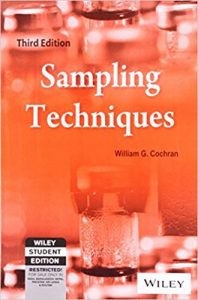
The first one is Sampling Techniques (3rd ed.) by William G Cochran.  This is a textbook (meaning that it is expensive), but one can find used copies online for under $15. It is extremely comprehensive and perhaps too advanced for our needs. However, it is the best textbook on the subject available for the money, in my opinion.

The next book I will recommend is actually free. The best all around publication, in my opinion, on concepts and techniques for conducting statistical tests is GAO’s Using Statistical Sampling, publication PEMD-10.1.6, freely available online for download. Click on the image above to go to the site.

Now, after sending you reading, I should say that, in order to conduct a statistical sampling inventory we need to know very little statistics.  A lot of the confusion is driven by the terminology and interpretation, which is why it helps to understand the background.


Engineering and Logistics

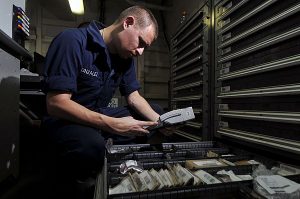
(U.S. Navy photo by Mass Communication Specialist Apprentice Andrew K. Haller/Released)

To those unfamiliar with the field of military logistics, it might come as a surprise that the discipline they understand simply as “logistics”, in its full breadth and scope, is actually Logistics Engineering science.  Although my job has me spending a lot of time on the field in warehouses and labs, even members of my own family express surprise when they learn that my academic background is in computer science and mathematics. People who are familiar with concepts such as reliability engineering, forecasting, and data analytics, immediately understand the relationship between logistics and engineering.

After I retired from the Navy, I was fortunate to join the American Society of Naval Engineers (ASNE) and felt right at home. Even more so, after I read their code of ethics and recognized it as many of my own personal principles that I had been following throughout my career. Therefore, I would like to share those principles with the readers and hopefully they will be of use:

American Society of Naval Engineers (ASNE) Code of Ethics

1. We will only accept assignments we are qualified to perform, and we will perform at a high level of professional competence.

2. We will conduct ourselves in accordance with both the letter and the spirit of the applicable laws and regulations of jurisdictions where we perform engineering within our discipline.

3. We will be alert to the totality of our conduct so that a series of actions, each falling within the technical parameters of the law, when viewed together will not give the appearance of improper or unethical behavior.

4. We will not accept assignments that place us in conflicting roles that may bias our objectivity or judgment. Compensation will not be accepted from more than one party, even if permitted by law, without the full knowledge of all parties involved. Real or apparent conflicts of interest will be fully disclosed to the affected clients at the earliest opportunity.

5. We will not disclose sensitive information to third parties without specific authorization. Sensitive information obtained will be safeguarded from disclosure.

6. We shall neither discriminate against nor deny equal professional service to any person for reasons of age, race, creed, sex, or country of national origin.

7. We shall neither seek unfair advantage over other naval engineers nor publicly disparage the professional performance of another engineer and shall perform engineering within our discipline so as to avoid unnecessary controversy.

8. We shall conduct business and advertise in a restrained and highly professional manner avoiding exaggeration and misrepresentation.

9. We will work to the mutual benefit of the Society and the Naval Engineering profession by sharing the lessons of experience and professional study with fellow naval engineers.

Book recommendation of the month

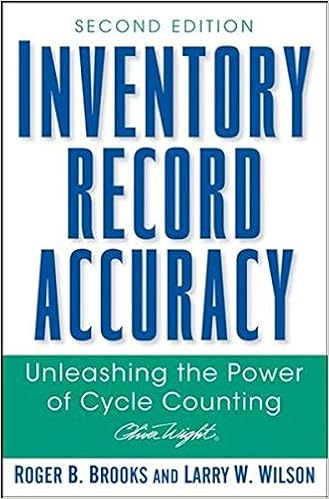
This month’s book review/recommendation is Inventory Record Accuracy by Roger Brooks and Larry Wilson.

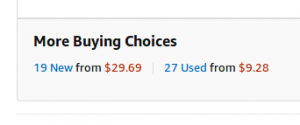
As some of you know, I am an avid/compulsive reader. One of my pastimes is to cruise around Amazon.com and look for bargains on books that I might want to read,.  I look under the “more buying choices” and see what is available. If I see a bargain, I jump on it like in the below example where I bought a book for under $10.

The reason I am sharing this is because my main issue with this book is that it might seem too expensive to most people. I actually scored a used copy for under $40. The book is currently listed at $106. I kept seeing this book quoted in research articles related to inventory accuracy, so I had to see for myself what all the hype was about.

Setting that negative aside, the content of the book is excellent. Even though the authors go into some complex technical details, the book never stops being approachable and easy to read. At 175 pages of text, it is amazing how much information is conveyed without wasting too much space.

Most complex technical concepts and techniques, such as variance, tolerance, sampling, etc. are discussed and illustrated with examples and relatively simple graphs.

The inventory concepts discussed in the book are from the point of view of commercial industry and best practices with some side-bars on government regulations. This, to me, was the most useful approach.

I recommend this book to anyone who is involved in inventory management, stock control, inventory accuracy officers, etc.

History of the Material Label Tool

Why the tool
The application was created starting in 2013 out of necessity and for my own use to test barcode label printers; then in 2014 my customer contacted me with a request. I was presented with a challenge – find something to do with the wall-to-wall inventory team during their downtime. Labeling was the most pressing need that my customer had at the time.  However, none of these contractors (or I) had Navy ERP access and I did not want to show up at a site and ask the warehouse staff repeatedly to print individual labels for us. So I had to devise a way to easily print labels in bulk, preferably before I showed up on-site. So I took my own Access tool and began turning it into something more user-friendly. I must admit that my early inspiration was NAVSUP BSC’s bin label tool that was written in Excel and VBA. However, because the file was encrypted, I stopped being able to use it in 2013 when its encryption certificate expired and that was the reason I started developing my own tool. Continue reading “History of the Material Label Tool”

Material Management Life Cycle

One of the risks that we all must face as logisticians is in understanding and acknowledging the mission that our processes are designed to support within our respective organizations.

Many years ago, when I was in graduate school, I was exposed to the concept of Michael Porter’s Value Chain, where the primary activities of an organization or business are identified as activities that create value, while secondary activities are identified as those that support the organization.

Michael Porter’s Value Chain Model

Continue reading “Material Management Life Cycle”

What’s the formula for statistical sampling?

Statistical sampling, for some reason, is one of those concepts that gives some people a lot of trouble. There is a book by Daniel Kahneman titled “Thinking, Fast and Slow” that I always recommend. One of the concepts Kahneman likes to write about is System 1 thinking vs. System 2 thinking. I suppose that those who feel comfortable when dealing with uncertainty and probabilistic models are people who are good system 2 thinkers.

So, what is statistical sampling? To keep things simple, it may be better that we start with an example.
Continue reading “What’s the formula for statistical sampling?”

The NSN (Part 2)

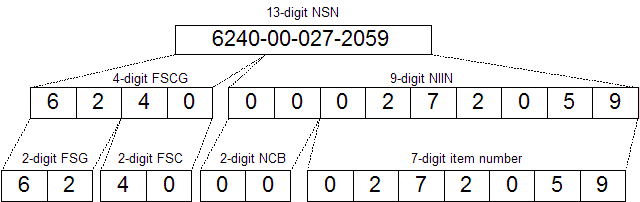
In this post, we will expand on the NSN concept that we introduced in part 1.

Let us start with a simple mental exercise. Can you tell what type of number this is?

(866)555-5555

If you said a telephone number, you are correct. We have also been conditioned to recognize even more obscure numbers such as 012-01-01234 (social security number), or 12345-1234 (zip +4). If someone asked us to pick out the area code or prefix from the telephone number above, most of us would know the answer.

The NSN, for those with even a vague familiarity with DoD logistics is also just as easily recognizable.
Continue reading “The NSN (Part 2)”

The National Stock Number (NSN) System – Part I

Why NSNs? As I mentioned in previous articles, almost every product sold in the world, at any store, has a reference number. This number can be a Universal Product Code (UPC), a Unique Product Identifier (UPI), a Model Number, a Manufacturer Part Number, Drawing Number, SKU, UPC, EAN, ISBN, etc.

Manufacturer Part Numbers (MPN) are assigned by each manufacturer using their own criteria. There is no enforced standard for the MPN, although there are some industry conventions.

For example, one manufacturer might produce an item and assign it part number A123, while another manufacturer might produce a completely different item and also assign the same part number. Additionally, different manufacturers implement different business rules regarding the significance of the part number itself. For example, the use of spaces or dashes might be significant to one manufacturer but completely irrelevant to another.

For this reason, the US, NATO, and other governments adopted a means of assigning the same catalog number to items that have common technical characteristics. This is done using the NSN.

Continue reading “The National Stock Number (NSN) System – Part I”